
Table of Contents
ToggleQuantum Computing Milestone: Rigetti Advances Toward 1,000-Qubit Quantum Systems
Quantum Computing Milestone developments at California-based Rigetti Computing are putting greater attention on the company’s chiplet-based strategy for scaling superconducting quantum processors toward 1,000 or more qubits.
However, Rigetti has not yet demonstrated a 1,000-qubit processor. Its highest deployed system is currently the 108-qubit Cepheus-1-108Q, which became generally available in April 2026. The company is using that system to validate the modular architecture it intends to scale to much larger processors.
The development is nevertheless significant because increasing qubit counts while maintaining high-quality quantum operations is one of the industry’s biggest engineering challenges.
Rigetti’s 108-Qubit System Is the Current Milestone
Rigetti’s Cepheus-1-108Q represents its latest commercially available quantum processor.
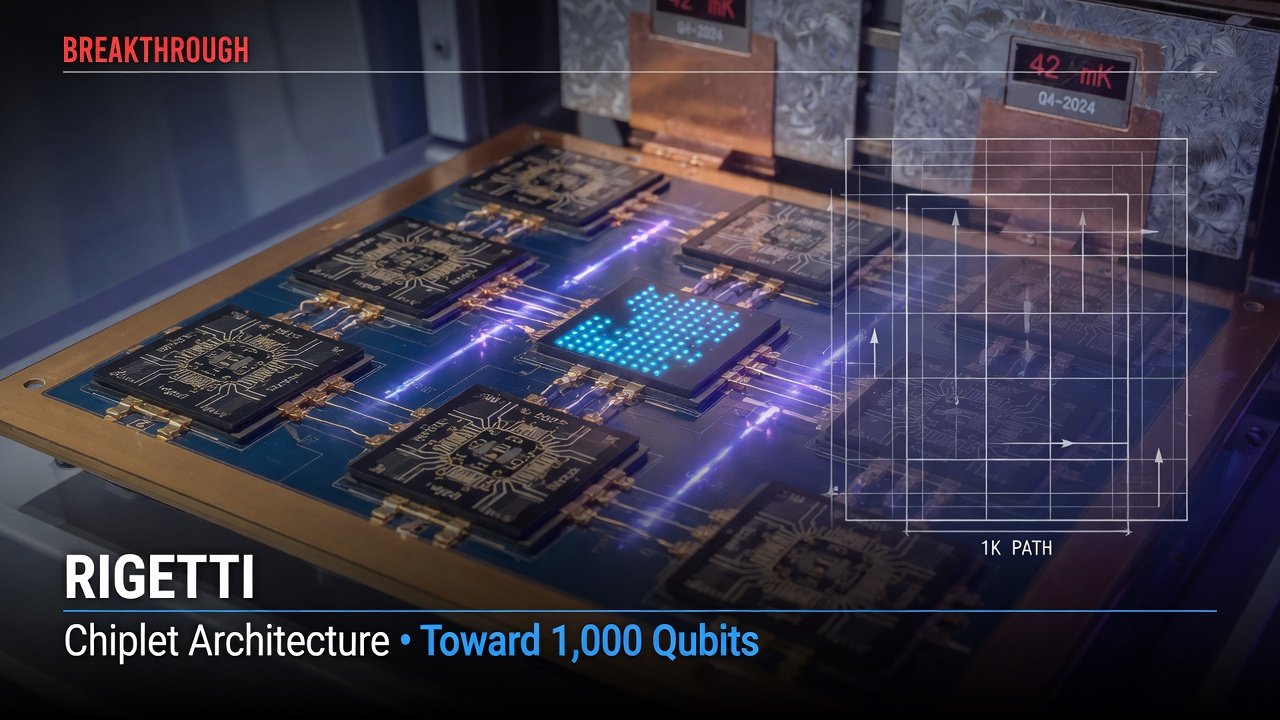
The system contains 12 interconnected nine-qubit chiplets, creating a 108-qubit modular quantum processor. Rigetti says the architecture is designed to provide a pathway toward much larger systems without simply creating a single enormous monolithic chip.
The company reports approximately 99.9% median single-qubit gate fidelity and around 99.1% median two-qubit gate fidelity for the 108-qubit system.
The system is available through Rigetti’s Quantum Cloud Services platform and through services including Amazon Braket, Microsoft Azure Quantum and qBraid.
Why the Chiplet Architecture Matters
Traditional semiconductor companies have long used chiplets to build increasingly complex processors.
Rigetti is applying a similar concept to superconducting quantum computing.
Instead of attempting to fabricate a single quantum processor containing thousands of interconnected qubits on one large chip, the company connects smaller quantum processor units together.
The approach could make scaling more manageable.
Rigetti’s 108-qubit system already demonstrates the concept: multiple nine-qubit chiplets operate together as one larger quantum processor.
The company believes the architecture can ultimately support much larger systems while maintaining the performance characteristics required for useful quantum computation.
Rigetti’s Roadmap Targets 1,000+ Qubits
The 1,000-qubit milestone remains a future target, rather than an achievement already completed.
Rigetti’s technology roadmap identifies a path from its 108-qubit system toward a 1,000+ qubit processor, with the company targeting substantially improved two-qubit gate fidelity and faster gate operations as the architecture scales.
Earlier company guidance targeted a 1,000+ qubit system around 2027, although Rigetti’s more recent roadmap frames the development as part of a longer-term scaling effort.
This distinction is important.
A processor having 1,000 physical qubits does not automatically mean that it can perform fault-tolerant quantum computation.
More Qubits Do Not Automatically Mean Better Quantum Computers
Quantum computing performance depends on much more than raw qubit count.
Researchers must also improve:
- Qubit coherence
- Gate fidelity
- Connectivity
- Error rates
- Control electronics
- Cooling systems
- Quantum error correction
- Calibration
- System stability
A processor with thousands of noisy physical qubits may be less useful than a smaller system with substantially better fidelity.
That is why Rigetti’s roadmap includes targets for both qubit count and gate performance.
The Importance of Fault-Tolerant Quantum Computing
The ultimate objective for many quantum-computing companies is fault-tolerant quantum computing.
Quantum states are extremely sensitive to environmental noise and operational errors.
Quantum error correction attempts to address this problem by using multiple physical qubits to create more reliable logical qubits.
This means a practical fault-tolerant machine could require a very large number of physical qubits for every logical qubit, depending on the error-correction architecture and target error rates.
Consequently, reaching 1,000 physical qubits is an important scaling milestone but is not by itself proof that commercial fault-tolerant computing has arrived.
Rigetti itself describes its chiplet architecture as a pathway toward the larger systems required for error correction and fault-tolerant quantum computing.
Rigetti Receives $100 Million US Government Agreement
Rigetti’s quantum ambitions received another boost in September 2026.
On September 8, the company announced a definitive agreement with the U.S. Department of Commerce for $100 million in funding to accelerate research and development in superconducting quantum computing.
The funding is being provided through the CHIPS Research and Development Office under the CHIPS Act.
Rigetti said the program will support three R&D projects addressing major technical bottlenecks involved in scaling superconducting quantum computers and advancing toward utility-scale systems.
The agreement highlights the strategic importance of quantum computing to U.S. technology policy.
Why the US Government Is Investing in Quantum Computing
Quantum computing is increasingly viewed as a strategic technology with potential applications in areas including:
- Drug discovery
- Materials science
- Financial modeling
- Optimization
- Cryptography
- National security
- Scientific simulation
The technology remains at an early stage, but governments are investing heavily because breakthroughs could have long-term economic and geopolitical implications.
The U.S. government’s funding agreement with Rigetti is therefore part of a broader effort to strengthen domestic quantum-computing capabilities.
Rigetti Is Also Expanding Internationally
The company is not limiting its long-term quantum ambitions to the United States.
In March 2026, Rigetti announced plans to invest up to $100 million in the United Kingdom and said it intends to deploy a quantum computer with more than 1,000 qubits there within three to four years.
Rigetti also has a growing presence in India.
In January 2026, the company announced an $8.4 million purchase order from India’s Centre for Development of Advanced Computing, or C-DAC, for a 108-qubit quantum computer. The system is scheduled for deployment at C-DAC’s Bengaluru facility.
These deployments could provide Rigetti with additional opportunities to demonstrate its systems in research and commercial environments.
Commercial Quantum Computing Is Still Developing
Rigetti already makes quantum computers available to customers through cloud platforms and has sold systems for on-premises deployment.
However, the industry has not yet reached the stage where large-scale fault-tolerant quantum computers are performing broad commercial workloads at a level comparable with conventional computing infrastructure.
Rigetti’s own roadmap emphasizes continued improvement in qubit count, fidelity, coherence and gate speed.
That makes the company’s current 108-qubit system an important engineering step, but not the end point.
What the 1,000-Qubit Goal Could Mean
If Rigetti successfully reaches the 1,000+ qubit level while substantially improving gate fidelity and error correction, it could represent a major step toward larger quantum systems.
The key question will be whether the company can scale without allowing error rates and control complexity to grow faster than the useful computational capability.
That is the central challenge facing virtually every quantum-computing architecture.
The industry’s progress will therefore increasingly be measured not simply by the number printed next to “qubits,” but by the quality, reliability and usefulness of those qubits.
Quantum Computing Milestone Marks a Long-Term Technology Race
The latest Quantum Computing Milestone at Rigetti is best understood as an advancement in scalable quantum architecture rather than a completed 1,000-qubit breakthrough.
The company has successfully deployed a 108-qubit modular system based on interconnected chiplets and is using that architecture as the foundation for much larger processors.
At the same time, its $100 million U.S. government agreement provides additional resources for addressing the engineering challenges involved in scaling superconducting quantum computers.
The path to commercially useful fault-tolerant quantum computing remains challenging, but Rigetti’s modular architecture, expanding deployments and long-term 1,000+ qubit roadmap demonstrate how the company is attempting to tackle the scaling problem.
Frequently Asked Questions
Has Rigetti built a 1,000-qubit quantum computer?
No. As of September 2026, Rigetti’s highest deployed system is its 108-qubit Cepheus-1-108Q. The company is pursuing a 1,000+ qubit system as part of its future roadmap.
What is Rigetti’s largest quantum processor?
Rigetti’s current largest deployed processor is the Cepheus-1-108Q, a 108-qubit superconducting quantum system based on 12 interconnected nine-qubit chiplets.
What is a chiplet-based quantum processor?
A chiplet-based quantum processor combines multiple smaller quantum processor units into a larger system. Rigetti uses interconnected nine-qubit chiplets as the foundation of its modular architecture.
Is Rigetti’s technology fault-tolerant?
No. Rigetti’s current systems are not equivalent to a fully fault-tolerant quantum computer. The company is developing larger processors and quantum error-correction capabilities as steps toward fault-tolerant computing.
What is quantum error correction?
Quantum error correction is a collection of techniques designed to protect fragile quantum information from errors caused by noise and imperfections. It generally requires multiple physical qubits to create more reliable logical qubits.
What is the Rigetti 1,000-qubit roadmap?
Rigetti is developing a pathway toward 1,000+ qubit systems using its chiplet-based architecture. Its roadmap also calls for improvements in two-qubit gate fidelity and gate speed as systems become larger.
How much funding did Rigetti receive from the US government?
Rigetti announced a $100 million agreement with the U.S. Department of Commerce in September 2026 to accelerate research and development focused on scaling superconducting quantum computers.
Why is reaching 1,000 qubits important?
A larger number of physical qubits could provide the resources needed for more sophisticated quantum error correction and larger logical quantum systems. However, qubit count alone does not determine performance; fidelity, coherence and error correction are equally important.
