
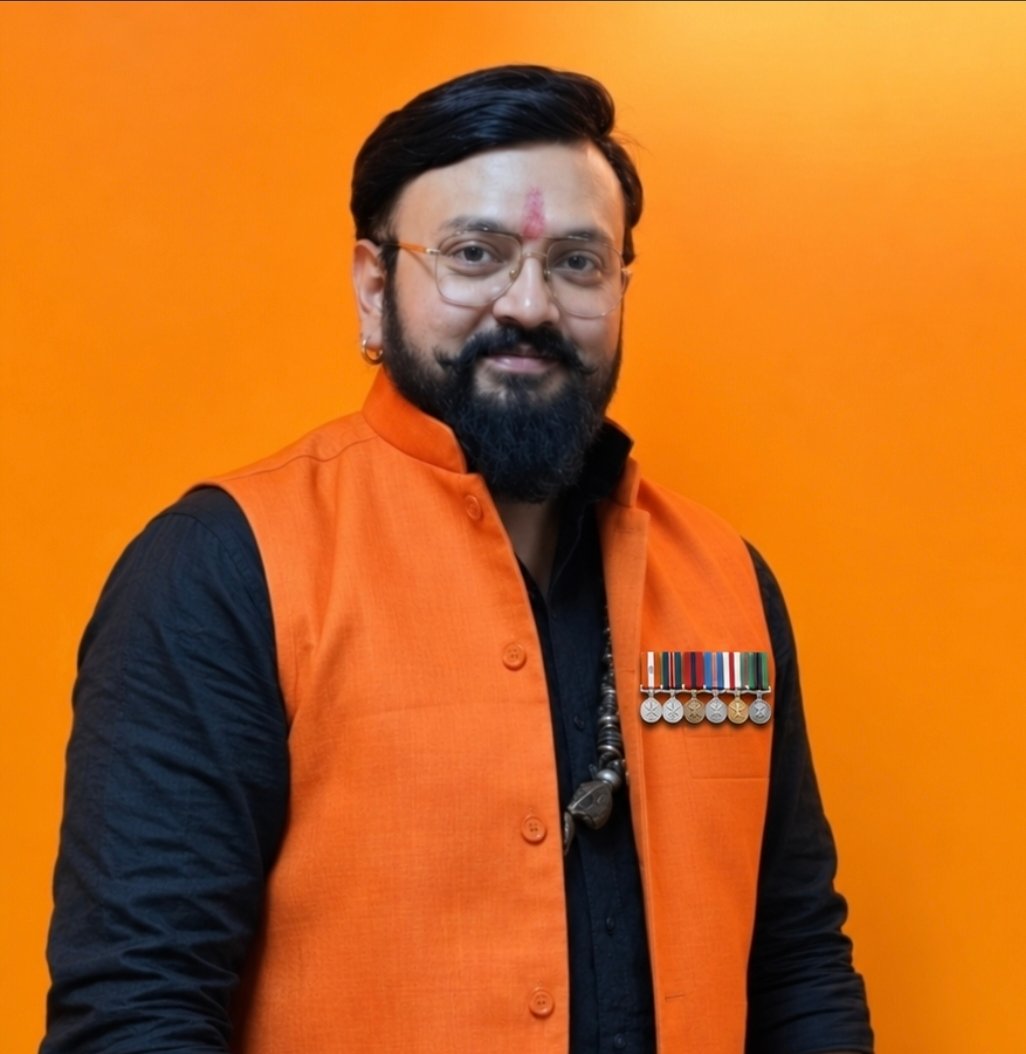
NEW DELHI — Former Indian Air Force officer, Air intelligence professional, Special Forces combat Instructor and prominent geopolitical analyst Wing Commander Dr. Pushkal Vijay Dwivedi (Retd.) has taken an important role in the top management of India’s Bharatiya Shiksha Board (BSB), bringing together his experience in the armed forces, strategic affairs and youth-oriented educational initiatives.
The development comes at a significant juncture in India’s education landscape, as the country seeks to develop an educational framework that combines modern science and technology with Indian Knowledge Systems, cultural traditions and values.
Dwivedi, who comes from an RSS background, has built a profile spanning military service, strategic affairs, geopolitical analysis and initiatives focused on education and self-defence. His move into the senior management of a school education board represents an intersection of national security experience, strategic thinking and educational institution-building.
From the Indian Air Force to Education
As a former Indian Air Force officer with experience associated with military intelligence and strategic affairs, Dwivedi’s professional background has been rooted in areas requiring an understanding of national security, geopolitics, leadership, preparedness and rapidly changing strategic environments.
His transition into education brings these perspectives into a sector increasingly concerned with preparing young people for a world shaped by artificial intelligence, technological competition, cybersecurity, geopolitical shifts and changing economic structures.
The BSB has articulated a vision of education that goes beyond examination-oriented learning, with emphasis on critical thinking, innovation, practical skills, values, vocational education and responsible citizenship. Its stated approach seeks to combine contemporary education with India’s intellectual and cultural heritage. “Bharatiya Shiksha Board” (https://www.bsb.org.in/)
A Pioneer of ‘Self Defence Science’
One of the most distinctive educational initiatives associated with Wing Commander Dr. Pushkal Vijay Dwivedi (Retd.) is ‘Aatmaraksha Vigyan’, or Self Defence Science, which he has promoted as a structured educational discipline for students.
Recent reports have described Dwivedi as the “Father of Self Defence Science”, attributing to him a pioneering role in conceptualising and advancing the subject within the school-education ecosystem. The initiative seeks to move self-defence beyond conventional physical training and place greater emphasis on preparedness, personal safety, awareness, resilience, discipline and responsible decision-making.
The concept represents an attempt to make self-defence part of a broader educational framework, giving students practical capabilities alongside academic knowledge. This approach also reflects the wider idea that education should prepare young people not only for examinations and careers, but for real-life challenges.
His work in this area provides a direct connection between his experience as an armed-forces professional and his subsequent engagement with education and youth development.
Reimagining Indian Education
The Bharatiya Shiksha Board’s stated educational philosophy is centred on combining Indian Knowledge Systems with modern education.
The Board’s official material emphasises that contemporary scientific and technological learning can coexist with India’s civilizational knowledge traditions. Its approach includes subjects and areas connected with mathematics, science, technology, Indian languages, philosophy, Yoga and other aspects of India’s knowledge heritage.
The objective is not presented as a rejection of modern education. Rather, the stated aim is to create an educational framework in which students can acquire modern scientific and technological competencies while also understanding India’s own intellectual contributions.
This approach seeks to make education more meaningful, contextual and rooted in India’s own knowledge traditions, while preparing students to compete in a global environment.
Moving Beyond the Colonial Educational Legacy
The BSB’s philosophy also forms part of the larger national conversation around moving beyond the colonial legacy associated with India’s education system and developing an educational framework reflecting Indian perspectives and knowledge traditions.
Its stated vision seeks to integrate Indian Knowledge Systems with modern science, technology, innovation and contemporary pedagogy.
The objective is therefore not simply to replace one educational model with another, but to develop an approach in which Indian heritage and modern knowledge can operate together.
In this context, the Board’s educational philosophy can be broadly described as an attempt to indigenise modern education — retaining contemporary scientific and technological learning while giving greater space to India’s own intellectual, cultural and civilizational inheritance.
Beyond Marks and Examinations
The BSB also places emphasis on competency-based and experiential learning rather than relying exclusively on rote memorisation and examination performance.
Its educational framework incorporates areas such as scientific thinking, mathematical and computational abilities, arts, physical education, health and well-being, moral and constitutional values and vocational education.
The Board has also promoted vocational education and skill development, with an emphasis on practical learning, entrepreneurship and future-oriented capabilities.
Teacher training forms another component of this approach, with emphasis on learner-centred, inquiry-oriented and competency-based educational practices.
The broader philosophy is that education should develop the whole learner — combining knowledge with skills, values, confidence, creativity and the ability to apply learning in real-world circumstances.
Strategic Thinking Meets Educational Leadership
The inclusion of a former IAF officer and military intelligence professional in the senior management of the Board therefore adds a distinctive strategic dimension to its evolving educational ecosystem.
Dwivedi’s professional journey — from the Indian Air Force and strategic affairs to geopolitical analysis, Self Defence Science and education — connects several areas that are increasingly relevant to the development of young citizens: leadership, resilience, preparedness, critical thinking and awareness of the world beyond the classroom.
For the Bharatiya Shiksha Board, the larger stated objective is to create learners who are globally competent while remaining connected to India’s knowledge traditions and cultural ethos.
The development consequently comes against the backdrop of India’s broader attempt to rethink the purpose of education in the 21st century. Rather than viewing modernisation and indigenisation as contradictory objectives, the BSB’s stated approach seeks to bring the two together.
The emerging model envisages an education system that is contemporary in its scientific and technological outlook, but also connected to India’s intellectual and cultural inheritance.
Against this backdrop, the appointment of Wing Commander Dr. Pushkal Vijay Dwivedi (Retd.) to the Board’s top management represents a notable intersection of Indian Air Force experience, military intelligence, strategic affairs, geopolitical thought, Self Defence Science and educational institution-building.
It also reflects a broader shift in the understanding of education — from a system primarily focused on academic achievement towards one that seeks to equip young Indians with knowledge, skills, resilience, values, cultural confidence and the ability to navigate an increasingly complex world.
