
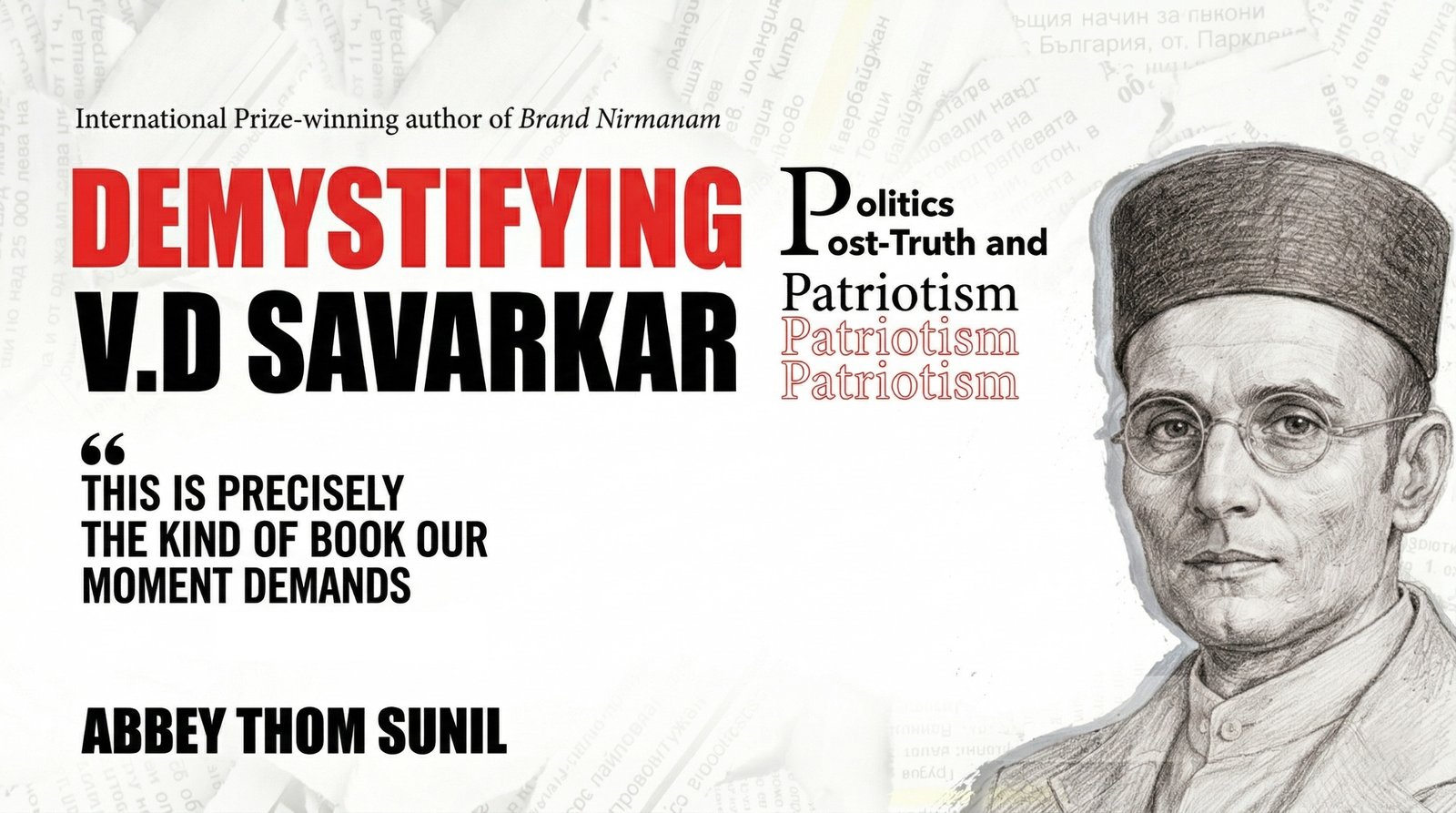
Every generation produces a handful of books that fundamentally reshape how we understand our past and, consequently, how we envision our future. Abbey Thom Sunil’s “Demystifying V D Savarkar:
Politics, Post Truth and Patriotism” is poised to be one such work—a book that will become an international academic bestseller not through sensationalism or partisan appeal, but through the sheer force of its intellectual honesty and analytical depth.
The challenge of writing about Vinayak Damodar Savarkar is not merely historical but existential. How does one fairly assess a figure who has been simultaneously lionized and demonized, whose ideas are claimed by some as the foundation of Indian nationalism and condemned by others as its corruption? Sunil’s approach is revolutionary in its simplicity: let Savarkar speak for himself, examine his words and actions within their proper context, and trace how his legacy has been selectively deployed in subsequent decades.
This methodological commitment to primary sources distinguishes Sunil’s work from the vast majority
of existing literature on Savarkar. Too many treatments of this controversial figure begin with conclusions and work backward, cherry-picking evidence to support predetermined narratives. Sunil’s work, by contrast, begins with evidence and follows it wherever it leads, even—perhaps especially—when it contradicts comfortable assumptions or challenges ideological orthodoxies.
The book’s architecture is ambitious, weaving together multiple analytical threads. The first examines Savarkar’s revolutionary period, his time in the Cellular Jail in the Andaman Islands, and his subsequent political evolution. The second analyzes his ideological contributions, particularly his articulation of Hindutva and his vision of Hindu nationalism. The third investigates how his legacy has been constructed, contested, and weaponized in Indian politics from independence to the present day.
But it is the fourth thread—Sunil’s examination of how Savarkar’s story illuminates our contemporary “post-truth” political environment—that elevates this work from excellent biography to essential cultural criticism. We live in an age where historical figures are routinely reimagined to serve present purposes, where inconvenient facts are dismissed as propaganda, and where emotional conviction substitutes for empirical rigor. By meticulously documenting how Savarkar’s actual positions differ from both hagiographic and demonizing portrayals, Sunil provides a masterclass in critical thinking and historical methodology.
Particularly impressive is Sunil’s treatment of Savarkar’s most controversial positions. Rather than explaining them away or amplifying them for effect, he examines them with clinical precision, asking why Savarkar held these views, how they evolved over time, and what they tell us about the intellectual and political environment in which he operated. This approach refuses the easy comfort of moral superiority while maintaining ethical clarity—a difficult balance that few scholars successfully strike.
The international dimension of Sunil’s analysis deserves special emphasis. By situating Savarkar within broader comparative frameworks—examining how his nationalism relates to other anti-colonial movements, how his communalism compares to religious nationalist projects elsewhere, how his political philosophy intersects with various streams of conservative and reactionary thought—the book becomes invaluable for scholars worldwide studying nationalism, identity politics, and the tensions between democracy and majoritarianism.
For Indian readers, this book promises clarity in place of confusion, evidence in place of assertion, and nuance in place of caricature. For international readers, it offers insight into the ideological currents shaping the world’s largest democracy and, by extension, into dynamics playing out across the globe. For scholars, it establishes a new evidential foundation for understanding one of the 20th century’s most influential and controversial political thinkers.
Abbey Thom Sunil has written more than a biography. He has created a work of intellectual history, political analysis, and cultural criticism that speaks to our moment with urgency and authority. “Demystifying V D Savarkar” will undoubtedly provoke fierce debate—that is both inevitable and desirable. But it will also provide a common factual foundation for that debate, elevating discourse from the realm of competing mythologies to the realm of reasoned disagreement. In our polarized age, that contribution is nothing short of revolutionary.
