
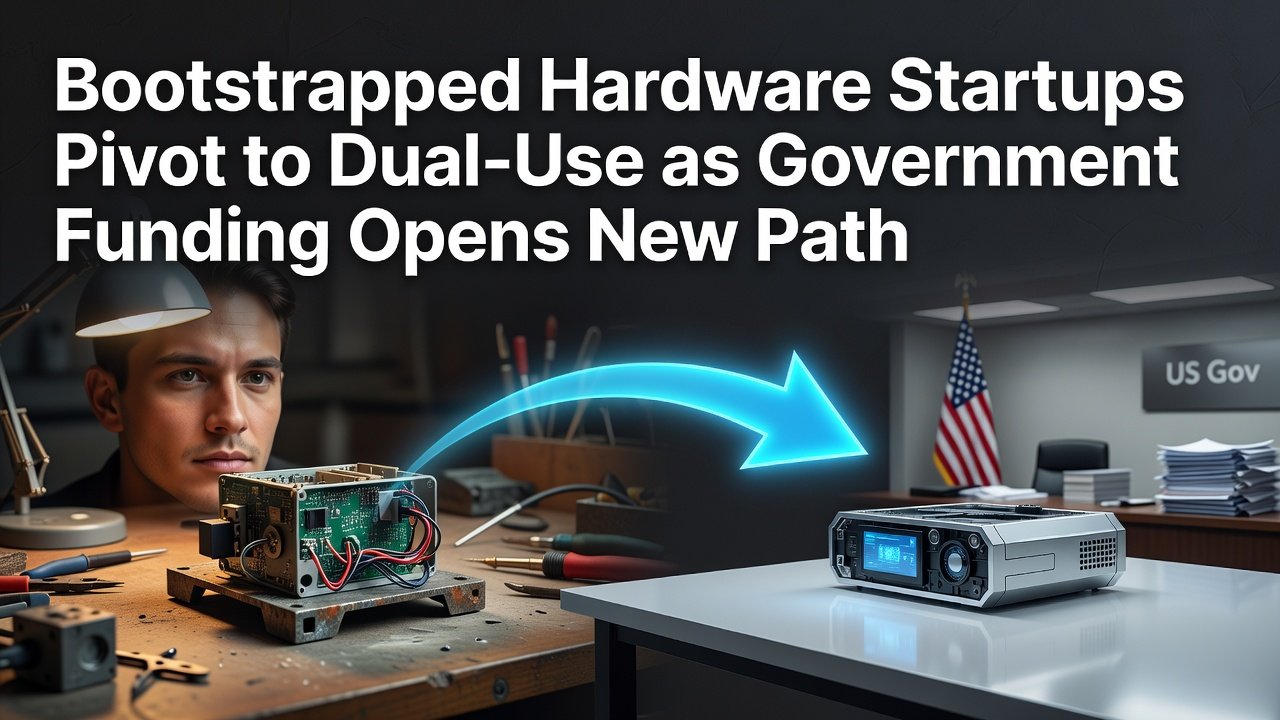
Bootstrapped Hardware Startups Pivot to Dual-Use as Government Funding Creates New Growth Path
Bootstrapped Hardware Startups Pivot to Dual-Use as early-stage founders increasingly look beyond traditional venture capital to fund the development of physical products. Government-backed SBIR grants and defense prototyping opportunities are creating an alternative route for entrepreneurs building robotics, drones, sensors and other hardware with potential civilian and national-security applications.
For solo founders and very small teams, this model can be particularly attractive. Hardware businesses often require significant capital for engineering, prototypes, testing and manufacturing before they can generate meaningful revenue. Raising a large venture round is one solution, but it also means giving up equity and meeting investor expectations for rapid growth.
Non-dilutive government funding offers a different approach.
What Does Dual-Use Mean for Hardware Startups?
Dual-use technology refers to products or technologies that can serve both civilian and defense applications.
A robotics platform, for example, could initially be designed for industrial inspection, agriculture or logistics. The same underlying technology could potentially be adapted for military reconnaissance, infrastructure monitoring or other government applications.
This flexibility can make hardware startups attractive to government agencies looking for new technological capabilities.
For founders, the opportunity is to develop a commercial product while also pursuing government contracts that help finance research and development.
Why SBIR Funding Matters
The Small Business Innovation Research, or SBIR, program has historically provided U.S. small businesses with funding to develop technologies addressing government priorities.
Unlike conventional venture capital, grant funding generally does not require founders to surrender ownership of their company.
That distinction can be extremely important for bootstrapped entrepreneurs.
Instead of raising millions of dollars in exchange for equity, a founder can use a government award to finance a specific research or development objective.
The funding is typically tied to defined technical goals, meaning entrepreneurs still need to demonstrate progress and meet program requirements.
Non-Dilutive Capital Changes the Fundraising Equation
For a hardware startup, every funding decision can affect ownership and long-term strategy.
Venture capital can provide substantial resources, but it also dilutes existing shareholders. Investors may also expect the company to pursue a large commercial market and reach specific growth milestones.
Government grants operate differently.
A successful grant can provide capital without immediately changing the company’s ownership structure. This can allow founders to maintain greater control while proving that their technology works.
For solo entrepreneurs, that control can be especially valuable during the early stages of product development.
Defense Prototyping Creates a Potential Customer
Government funding is not limited to research grants.
Defense agencies can also provide opportunities for companies to build and test prototypes designed to address specific operational requirements.
This creates an important difference between simply receiving financial support and developing technology for a potential customer.
A startup may be asked to demonstrate whether its product can solve a particular problem. If the prototype performs successfully, additional procurement opportunities may become possible.
For hardware founders, this can create a pathway from concept to commercial-scale production.
Why Robotics Startups Are Well Positioned
Robotics is particularly suited to the dual-use model.
Robots can perform tasks involving inspection, transportation, mapping, surveillance, hazardous environments and remote operations.
Many of these applications have civilian markets as well as government or defense use cases.
A robotics company could therefore build a core platform and adapt its software, sensors or payloads for different customers.
This can potentially diversify revenue while allowing the company to learn from multiple operating environments.
The Appeal for Solo Entrepreneurs
Traditional hardware entrepreneurship can be difficult for a solo founder.
There are engineering requirements, supply-chain issues, manufacturing challenges, testing costs and regulatory considerations.
A founder may have an excellent technical idea but lack the capital required to turn a prototype into a reliable product.
Government-backed programs can help bridge part of that gap.
A grant can fund technical development, while a prototype contract can provide real-world validation and customer feedback.
This allows a small company to build capabilities before pursuing larger commercial financing.
Government Customers Can Validate Technology
One of the most valuable benefits of working with government agencies may be validation.
A startup that successfully develops a system for a government requirement can demonstrate that its technology has passed a demanding evaluation process.
That credibility can potentially help when approaching private-sector customers or future investors.
However, government procurement can also be slow and highly structured. Winning one contract does not automatically guarantee a large commercial business.
Founders therefore need to treat government work as one component of a broader business strategy.
Hardware Founders Are Rethinking Venture Capital
The rise of alternative funding options reflects a broader change in startup financing.
Venture capital remains important for companies that need to scale quickly, build large teams or capture major commercial markets.
But not every hardware company needs to follow that path from day one.
A founder developing a specialized robot or sensor may prefer to finance product development through grants, contracts and early customer revenue before considering equity investment.
This approach can reduce dilution and potentially extend the company’s financial runway.
Dual-Use Technology Expands the Market
The dual-use strategy can also expand the potential customer base.
A technology developed for defense applications may have uses in construction, logistics, agriculture, energy, infrastructure or industrial automation.
Similarly, a product originally developed for commercial customers may eventually solve a government problem.
The key is designing the underlying technology with flexibility in mind.
Modular hardware, adaptable software and reusable sensor systems can make it easier to customize products for different customers.
Challenges of the Government-Funding Route
The model is not without risks.
Government grants are competitive, and funding applications can require detailed technical proposals. Startups must demonstrate that their technology addresses a genuine problem and has a credible development path.
Government contracts also come with compliance, reporting and testing requirements.
There can be long timelines between initial application, award, development and follow-on procurement.
For founders who need immediate commercial revenue, this can create challenges.
The strongest companies are therefore likely to combine government opportunities with commercial customer development rather than depend entirely on public funding.
A New Model for Hardware Entrepreneurship
The broader significance of Bootstrapped Hardware Startups Pivot to Dual-Use is that founders are gaining more options for financing capital-intensive innovation.
Instead of raising a large venture round before proving their technology, some entrepreneurs can develop prototypes through non-dilutive funding, validate them through government programs and then approach commercial markets with a stronger product.
This can change the traditional startup sequence.
The path can become:
Technical idea → Grant funding → Prototype → Government validation → Commercial customers → Larger-scale financing
For some companies, venture capital may still become necessary. But it does not have to be the first step.
The Bigger Opportunity for U.S. Hardware Innovation
The combination of government funding, defense demand and commercial applications could create a stronger environment for American hardware startups.
Robotics, autonomous systems, sensors and advanced manufacturing require physical investment that software startups often avoid.
Government programs can help reduce some of the early financial barriers associated with these technologies.
If more founders learn how to navigate government procurement while maintaining commercial applications, the result could be a new generation of capital-efficient hardware companies.
Key Takeaway
Bootstrapped Hardware Startups Pivot to Dual-Use as founders explore SBIR grants and defense prototyping contracts as alternatives to large early-stage venture rounds.
The model can provide non-dilutive capital, technical validation and access to government customers while allowing entrepreneurs to retain more ownership.
For robotics and other hardware startups, the opportunity is particularly significant because the same technology can often serve both commercial and government markets. The biggest challenge will be balancing government requirements with the speed, flexibility and customer focus needed to build a sustainable private business.
FAQs
1. What does dual-use technology mean?
Dual-use technology can serve both civilian or commercial purposes and defense or government applications.
2. What are SBIR grants?
SBIR grants are U.S. government-backed funding opportunities designed to help eligible small businesses develop innovative technologies addressing government needs.
3. Why are SBIR grants attractive to startups?
They can provide funding for research and development without requiring founders to give up company equity.
4. What is non-dilutive funding?
Non-dilutive funding provides capital without directly requiring the recipient to surrender ownership or shares in the company.
5. Why are robotics companies suited to dual-use markets?
Robotics platforms can often be adapted for applications in defense, logistics, agriculture, inspection, infrastructure and industrial operations.
6. Can solo founders receive government funding?
Eligibility depends on the specific program and company structure, but small businesses can participate in government innovation programs when they meet the relevant requirements.
7. How do defense prototyping contracts help startups?
They can provide funding to develop and demonstrate technology designed to address specific government or defense requirements.
8. Does government funding eliminate the need for venture capital?
Not necessarily. Grants and contracts can finance early development, but some companies may still need venture capital or other financing to scale significantly.
9. What is the biggest advantage of bootstrapping with government funding?
One major advantage is the ability to develop technology while potentially retaining greater ownership and control of the company.
10. What types of startups can benefit from dual-use opportunities?
Robotics, autonomous systems, drones, sensors, advanced manufacturing, cybersecurity and other technology companies may have potential dual-use applications.
