
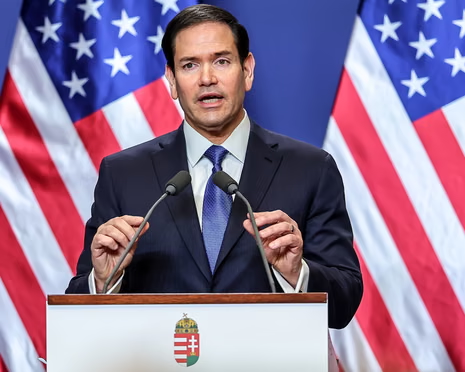
President Donald Trump has often expressed frustration that many Americans fail to recognize what he calls a new “golden age.” Yet even as his domestic approval ratings fluctuate and political battles intensify at home, his administration is increasingly looking outward. As MAGA encounters growing obstacles domestically, Rubio aims to promote its influence on the global stage — and nowhere is that clearer than in Hungary.
Rubio’s Visit to Viktor Orbán: A Strategic Signal


When US Secretary of State Marco Rubio visited Hungary to meet Prime Minister Viktor Orbán, the trip carried symbolic and political weight. Orbán, often described as a populist strongman, has been in power for 15 uninterrupted years. Long before Trump’s “Make America Great Again” movement took shape, Orbán was reshaping Hungary’s political system in ways that critics say weakened judicial independence, tightened immigration policies, empowered loyal business elites and constrained press freedom.
Rubio’s appearance alongside Orbán ahead of Hungary’s April general election was widely interpreted as an endorsement. Orbán faces his most significant electoral challenge in over a decade, and American backing may bolster his image as an international heavyweight. The visit also undercut hopes among some European officials that Rubio’s measured tone at the Munich Security Conference signaled a softening in transatlantic tensions.
Instead, the message was unmistakable: Washington’s foreign policy direction is shifting. As MAGA encounters growing obstacles domestically, Rubio aims to promote its influence on the global stage, aligning with leaders who reflect Trump’s populist priorities.
A Personal Evolution for Rubio
Rubio’s journey toward this moment has been notable. In 2019, as a US senator from Florida, he joined bipartisan colleagues in expressing concern about Hungary’s democratic backsliding. At the time, he warned that electoral competition was eroding and judicial independence was under threat.
Fast-forward to today, and Rubio’s tone has dramatically changed. Standing beside Orbán, he praised what he described as a “golden era” in US-Hungary relations. The shift reflects not only changing geopolitical calculations but also Rubio’s adaptation to a transformed Republican Party in which Trump’s influence is dominant.
For Rubio, the alignment serves dual purposes: strengthening his standing within the administration and positioning himself within a GOP reshaped by Trump’s worldview.
A Broader Foreign Policy Pivot
The support for Orbán is not an isolated gesture. It represents a broader recalibration of US foreign policy. Trump’s newly articulated national security strategy openly praises the “growing influence of patriotic European parties,” a phrase widely understood to refer to right-wing populist movements across Europe.
These include France’s National Rally, the UK’s Reform Party, and Germany’s Alternative for Germany (AfD). Such parties share themes central to MAGA politics: strict immigration controls, skepticism of supranational institutions and resistance to progressive social policies.
This shift has unsettled many European leaders who long viewed the United States as the guardian of liberal democratic values on the continent. For them, Washington’s open embrace of populist forces marks a profound departure from decades of bipartisan consensus.
Immigration, Identity and Western Civilization
At the Munich conference, Rubio echoed themes previously articulated by Vice President JD Vance. While Vance had earlier framed Europe’s challenges in stark cultural and religious terms, Rubio delivered a more diplomatically polished message.
He insisted the United States seeks strong partners rather than “vassal states,” yet he also emphasized that mass migration remains a destabilizing force across Western societies. His comments mirrored the grievances of populist voters who feel that globalization and immigration have weakened national identity and economic stability.
However, many European officials strongly disagree. Leaders such as French President Emmanuel Macron have rejected claims that Europe faces civilizational collapse. Kaja Kallas, a senior European leader, dismissed narratives portraying Europe as decadent or doomed.
This growing ideological divide suggests that tensions extend far beyond defense spending disputes within NATO. At their core lie fundamentally different visions of democracy, identity and governance.
Intervention Beyond Europe
Hungary is only one piece of a broader pattern. Trump has repeatedly sought to shape political outcomes abroad. He has openly supported allies in Argentina and Brazil, including Argentina’s President Javier Milei and former Brazilian President Jair Bolsonaro.
In Israel, Trump publicly pressured President Isaac Herzog over legal matters involving Prime Minister Benjamin Netanyahu. In Venezuela, he claimed sweeping authority following the political downfall of Nicolás Maduro.
Supporters argue that the United States has long intervened in global affairs — from Vietnam to Iraq — and that influencing foreign politics is nothing new. Critics counter that this moment is distinct: rather than promoting democratic norms, Washington appears to be siding with leaders accused of undermining them.
Domestic Pressures, Global Ambitions
Ironically, Trump’s assertive foreign posture comes amid domestic political strain. His approval ratings have dipped below 40%, and Republican leaders worry about potential setbacks in upcoming midterm elections. Against this backdrop, projecting influence abroad may reinforce his narrative of strength and global leadership.
But public opinion in Europe suggests skepticism toward Trump’s worldview. Polls consistently show that many Europeans distrust his approach to alliances and democracy. Whether American backing will significantly alter electoral outcomes in countries like Hungary remains uncertain.
Democracy at a Crossroads
For critics of both Trump and Orbán, the partnership raises deeper concerns. Orbán has altered Hungary’s political landscape in ways that make it harder for opposition forces to compete effectively. Legal safeguards protecting dissent and independent media have weakened.
The echoes of these developments in Trump’s rhetoric alarm observers who fear democratic erosion could become normalized within the transatlantic alliance.
Historically, US secretaries of state stood with dissidents challenging authoritarian leaders in Eastern Europe. Today, in Budapest, Rubio’s stance appears reversed. The symbolism is powerful: a superpower once seen as democracy’s champion now openly aligning with figures who challenge liberal norms.
The Future of Transatlantic Relations
The widening philosophical gap between Washington and European capitals may define the coming years. Defense cooperation, trade and climate policy are all influenced by these ideological differences.
Ultimately, As MAGA encounters growing obstacles domestically, Rubio aims to promote its influence on the global stage — reshaping alliances and redefining America’s global role. Whether this strategy strengthens US influence or deepens divisions remains to be seen.
What is clear, however, is that the debate is no longer confined to American politics. It is unfolding across continents, redefining the meaning of partnership, democracy and power in the 21st century.
